

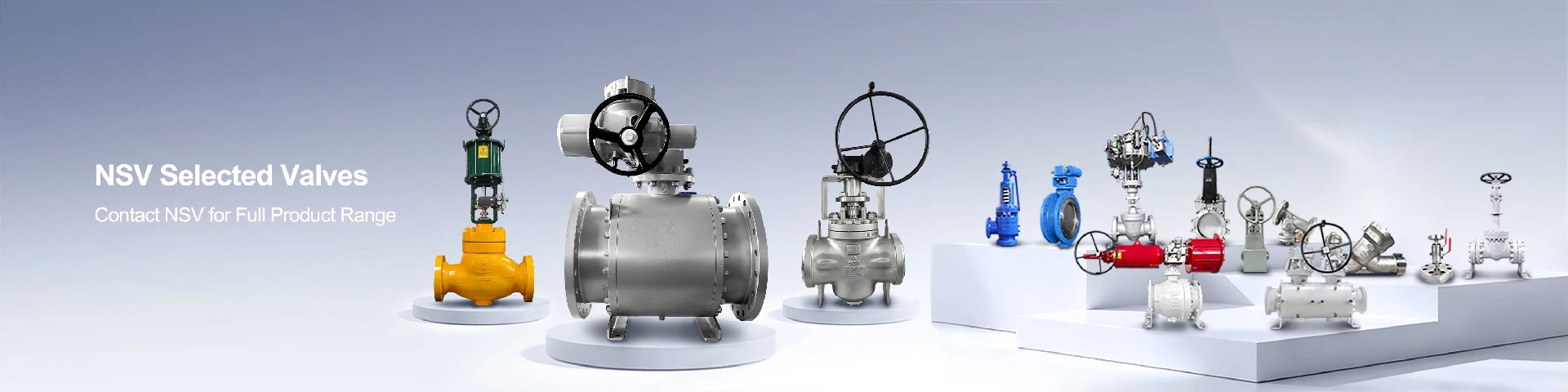
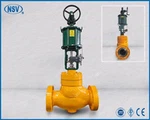

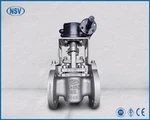
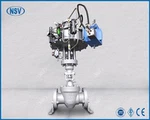


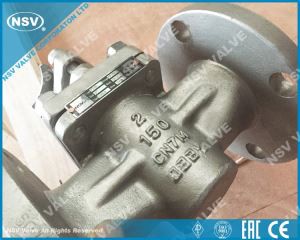
Stainless Steel Pneumatic Control Valve
NSV Valve Corporation is one of the most reliable manufacturers and suppliers of stainless steel pneumatic control valve in China. With a professional production team, we are able to meet the needs of the majority of our customers. Welcome to buy advanced stainless steel pneumatic control valve made in China here from our factory.
Product details
The Linear Motion Valves(also known as Multi-Turn Valves)are those valves that have a sliding stem design that pushes a closure element into the valve body which further regulates the open and close positions.
This kind of control valve is suitable for applications with relatively low differential pressure with tight shut-off. Its suitable for controlling medium flow or pressure.
Applicable Standard
Design Standard: ASME B16.34
Face to Face: MFG’S STANDARD
End Flange: ASME B16.5
Inspection and Test: ASME B16.104-1998-IV
Products Range
Size: 1/2” ~8”
Rating: CLASS 150,300,600
Body Materials: A351 CF8,CF8M,CF3,CF3M
Plug&seat: SS304,SS316,SS304L,SS316L
Cage: A351 CF8,CF8M,CF3,CF3M
Operation: Pneumatic diaphragm actuator,pneumatic piston actuator,electric actuator
Design Features
Trim features: Top guided,unbalanced trim
Quick disassembly cage structure
Body type: Straight-through type,angle type
Bonnet type: Standard type,heat dissipation type,cryogenic type,bellows
Flow characteristic: Equal percentage,linear,quick open
Shut-off class: ASME B16.104 V(standard metal seat)
ASME B16.104 VI(shut-off soft seat)
Application temperature range:-30~260C


Body Material:
Basic principles of selecting the materials
▲High temperature materials
The issues such as high temperature strength, change of metallurgical structure
under high temperature and anti-corrosion must be taken into full consideration during the selection of high temperature materials.
Generally, the alloy steel shall contain chrome, nickel, molybdenum, etc,In addition, under high temperature and high pressure, the steel will be eroded by hydrogen,which will cause decarburization and embrittlement. After being added into the steel, the elements such as chrome,nickel, molybdenum, etc. can enhance the hydrogen corrosion resistance of steel in combination with the element carbon.

Range of application of carbon steel and alloy steel under high temperature and high pressure hydrogen.
▲ Cryogenic materials
The cryogenic impact value of materials and the problem of embrittlement of materials under low temperature must be taken into full consideration during the selection of cryogenic materials. Therefore, the materials that are used in cryogenic service conditions must have sufficient toughness under low temperature. The valve will be safe and reliable only when the steel used in the valve meets the impact energy stipulated in relevant standards under the applicable temperature. The austenitic stainless steel is often adopted as its cryogenic mechanical property is relatively stable.

Cryogenic impact value of various materials(5mm U notch)
▲Anti- cavitation materials
When the fluid is liquid, especially when the occurrence of flash evaporation and
cavitation appears, the issue of anti-cavitation must be taken into full consideration. The anti-cavitation materials mainly include:
a) Materials of high hardness (the hardness is enhanced through heat treatment)
b) Materials with solid oxide layer and high toughness and fatigue strength (the hardness on the surface of the material is enhanced through surface heat treatment)
b)Materials with solid oxide layer and high toughness and fatigue strength (the
hardness on the surface of the material is enhanced through surface heat treatment)
c) Materials of partial hardening treatment (overlay welding treatment)
▲Anti-corrosion materials
The corrosion of metal materials include general corrosion, crevice corrosion, intergranuler corrosion,pitting corrosion, stress corrosion, etc. There is no material that can resist all the above corrosion. Actually, the corrosion of materials is related to the fluid type, concentration,temperature, flow velocity, and also depends on if the fluid contains oxidant. Thus, the selection of materials becomes more complex.
The anti- -orrosion materials commonly used in control valves mainly include PTFE, F46 and other lining materials or high-cost austenitic stainless stee, 20# alloy steel, Hastelly B, Hastelly C,titanium and other special metals.
Trim Material:
The commonly used trim materials include SUS 304, SUS 316,SUS316L,SUS 410,SUS420,etc.according to different fluids,the corresponding treatment is carried out.When the valve is used for controlling cavitation fluids containing solid granules or used in high temperature and high pressure applications,hardening treatment must be arrried out to prolong the service life of the valve.
The main methods of hardening treatment include:
1. Heat treatment
a.304/316 solid solution treatment
The series of materials is austenitic stainless steel which is mainly used in service conditions with corrosive media or low temperature applications. Solid solution treatment must be carried out when the media corrosion is relatively strong. The purpose of solid solution treatment is to enhance material hardness and anti- -corrosion performance.Working temperature range -196 - 530C
b.410/420 thermal refining treatment (quenching + tempering)
The series of materials is martensitic stainless steel which is an excellent anti- cavitation material. It shall be subjected to thermal refining treatment when used in high temperature and high pressure applications.The purpose of thermal refining treatment is to enhance
C.17- .4PH precipitation hardening treatment
Different types and quantities of reinforcing elements are added on the basis of the chemical components of stainless steel, and different types and quantities of carbides, nitrides, carbonitrides, intermetallic compounds are deposited through precipitation heat treatment. The process that forms high strength stainless steel with the steel strength being enhanced and sufficient toughness being maintained is called precipitation hardening.
Working temperature range -45 - 425C material hardness and prolong the service life under severe
service conditions.
2. Surface hardening treatment
Surface heat treatment includes two types: surface hardening, surface chemical heat treatment.
a. surface hardening by flame heating, surface hardening by contact heating, induced surface hardening, etc.
b. carburizing, nitriding, carbonitriding, boronizing, chromizing, copperizing, etc.
3. Overlay welding treatment
Stellite overlay welding (main elements Co, Cr, W) is the commonly used hardening treatment and excellent anticorrosive performance can be achieved.
Stellite overlay welding includes two modes such as full overlay welding and partial overlay welding. The selection of the overlay welding modes is not specially stipulated in a standard. The mode shall be selected according to different pressures and temperatures of the fluids and depends on if the fluids contain granules.
The types of overlay welding include:
Plug overlay welding treatment (Stellite overlay welding)

Seat overlay welding types(Stellite overlay welding)
FAQ
1.Q:How can I get your company catalog?
A: For your reference, basic catalogue is same as "Download>E-Catalog” of homepage. If you need printed material or request more specific data like PQ material, please contact sales team.
2. Q:Does your company have any agent/distributor with the exception of China?
A: At present,we have agent in Indonesia,Singapore,Canada,Mexico,Iraq,and welcome contact us if you would like to join us.
3. Q:Does “NSV” valves have supply to any value end user?
A:Yes,,it just like PETROKIMIA GRESIK in Indonesia, BP Iraq,ESFAHAN MOBARAKEH STEEL In Iran etc.
4. Q: I want to be registered as your agency.?
A: Defined inspection and manager’s approval shall be required for being registered as the company’s agency. For specific application method, please consult with sales team. If you are registered as the company’s agency, “Agency Certificate” will be issued.
5. Q:Are you manufacturer or trading company?
A: We’re manufacturer,but our factory name is not named NSV due to we’re professional in promotion NSV brand with best service,and also have sold to many end user success.
Hot Tags: stainless steel pneumatic control valve, China, manufacturers, suppliers, factory, made in China
You Might Also Like




Send Inquiry