

Corrosion failure analysis of stainless steel
1. Stress corrosion:
Stainless steel produces stress corrosion in a corrosive medium containing oxygen chloride ions. Stress corrosion failure accounts for about 45 %.
Common protective measures:
Reasonable selection of materials, the selection of stress corrosion-resistant materials are mainly high purity austenitic chromium nickel steel, high silicon austenitic chromium nickel steel, high chromium ferrite steel and ferritic - austenitic two-phase steel. Among them, ferritic - austenitic duplex steel has the best resistance to stress corrosion. Control stress: during assembly, reduce stress concentration as far as possible, and make the part in contact with the medium have the minimum residual stress, prevent collision and scratch, strictly comply with the welding process specification.
Strictly follow the operation rules: strictly control the raw material composition, flow rate, medium temperature, pressure, pH value and other technological indicators. Add corrosion inhibitor as far as process conditions permit. When using chrome-nickel stainless steel to dissolve aerobic chlorides, the mass fraction of oxygen should be reduced to less than 1.0 × 10⁻⁶. It has been proved by practice that in the water containing chlorine ion with a mass fraction of 500. 0 × 10-6, a mixture of nitrate with a mass fraction of 150. 0 × 10-6 and sodium sulfite with a mass fraction of 0.5 × 10⁻⁶ can obtain a good effect.
2. Hole erosion failure and preventive measures
Keyhole corrosion usually occurs in stationary media. The hole usually develops along the direction of gravity or transverse direction. Once the hole is formed, it will accelerate to the depth automatically. , the oxide film on the surface of the stainless steel is dissolved in an aqueous solution containing chloride ions, resulting in the formation of small pits with an aperture of 20 nm ~ 30 nm on the base metal. As long as there is a certain amount of chlorine ion in the medium, the corrosion core may develop into corrosion holes.
Common precautions: add molybdenum, nitrogen, silicon and other elements to stainless steel or increase chromium content while adding these elements. Reduce the content of chlorine ions in the medium. The corrosion inhibitor can increase the stability of the passivation film or facilitate the repassivation of the damaged passivation film. Adopt external cathode current protection, restrain the hole erosion.
3. Pitting corrosion
Due to the presence of non-metallic inclusions to varying degrees in any metal materials, these non-metallic compounds will soon form pit pitting corrosion under the corrosion action of Cl ions. Under the action of blocking batteries, Cl ions outside the pit will migrate to the pit, while metal ions inside the pit with positive charges will migrate to the pit. In stainless steel, the material with Mo is better than the material without Mo in corrosion resistance. The more Mo content is added, the better the corrosion resistance is.
4. Crevice corrosion
The mechanism of crevice corrosion is the same as pit pitting corrosion, which is caused by Cl ion enrichment due to the effect of occluded batteries in the crevice. This kind of corrosion generally occurs in the cracks of flange gaskets, lap joints, bolts and nuts, as well as in the cracks of heat exchange pipes and tube plate holes. Crack corrosion is closely related to the concentration of static solution in the cracks. Once there is a crack corrosion environment, the probability of inducing stress corrosion is very high.
Applicable conditions for two kinds of stainless steel in chlorine-containing aqueous solution
Type 1 304 stainless steel
This is the cheapest and most widely used austenitic stainless steel (such as food, chemical, atomic energy and other industrial equipment). Suitable for general organic and inorganic media. For example, nitric acid with concentration < 30%, temperature ≤100℃, or concentration ≥ 30%, temperature < 50℃; Various concentrations of carbonic acid, ammonia and alcohols at temperatures ≤100℃. Poor corrosion resistance in sulfuric acid and hydrochloric acid; It is especially sensitive to crevice corrosion caused by chlorine-containing media (such as cooling water).
2 304L stainless steel.
Corrosion resistance and use are basically the same as type 304. Due to lower carbon content (≤ 0.03%), corrosion resistance (especially intergranular corrosion resistance, including weld zone) and weldability are better, which can be used for semi-welded or full-welded PHE.
Type 3 316 stainless steel
Suitable for general organic and inorganic media. For example, natural cooling water, cooling tower water, softening water; Carbonate; Acetic acid and caustic soda solution with concentration < 50%; Solvents such as alcohol and acetone; Dilute nitric acid (concentration < 20% =, dilute phosphoric acid (concentration < 30% =, etc. However, should not be used for sulfuric acid. Because it contains about 2% Mo, the corrosion resistance in seawater and other chlorine-containing media is better than type 304, which can completely replace type 304.
4 316L stainless steel
Corrosion resistance and use are basically the same as type 316. Due to the lower carbon content (≤ 0.03%), the weldability and corrosion resistance after welding are also better, which can be used for semi-welded or full-welded PHE.
Type 5 317 stainless steel
Suitable for conditions requiring longer service life than type 316. Because the contents of Cr, Mo and Ni are slightly higher than those of type 316, the resistance to crevice corrosion, pitting corrosion and stress corrosion is better.
AISI 904L or SUS 890L stainless steel
This is a high-cost performance austenitic stainless steel with both price and corrosion resistance, its corrosion resistance is better than the above materials, especially suitable for general sulfuric acid, phosphoric acid and other acids and halides (including Cl -, F -). Due to the high content of Cr, Ni and Mo, it has good resistance to stress corrosion, pitting corrosion and crack corrosion.
7 Avesta 254 SMO superior stainless steel
This is an ultra-low carbon advanced stainless steel modified by increasing Mo content of type 316, with excellent resistance to chloride pitting and crevice corrosion, suitable for medium containing brine and inorganic acid that cannot be used in type 316.
8 Avesta 654 SMO superior stainless steel
This is an ultra-low carbon advanced stainless steel with higher Cr, Ni, Mo and N content than 254 SMO, which has better resistance to chloride corrosion than 254 SMO and can be used in cold seawater.
9 rs-2 (OCr20Ni26Mo3Cu3Si2Nb) stainless steel;
This is a domestic Cr - Ni - Mo-Cu stainless steel. Pitting and slot corrosion resistance is equivalent to type 316, and stress corrosion resistance is better. Can be used for concentrated sulfuric acid below 80 ℃ (concentration of 90~ 98%), annual corrosion rate ≤0.04mm/a.
10 Incoloy 825(S),
This is a Ni (40%) - Cr (22%) - Mo (3%) superior stainless steel. Incoloy is a registered trademark of the international Nickel Co. Suitable for various concentrations of sulfuric acid at low temperature; In solution of caustic soda (such as NaOH) with concentration of 50% ~ 70%, it has good corrosion resistance and does not produce stress corrosion cracking. However, it is sensitive to chloride-induced crevice corrosion. In addition, the stamping performance is not very good, so it is not a common plate material.
11 31 alloy
Modified by 904L (increased Mo, N content), standard 6% Mo superior stainless steel (31% ni-27% cr-6.5% mo-32% Fe). Corrosion resistance in many media is better than 904L; In sulfuric acid with a concentration of 20% ~ 80% and temperature of 60℃~100℃, the corrosion resistance even exceeds c-276.
12 33 alloy
A fully austenitized chrome-based superior stainless steel with corrosion resistance comparable to that of some ni-cr-mo alloys such as Inconel 625. In acidic and alkaline medium (including nitric acid, a mixture of nitric acid and hydrofluoric acid), it has good resistance to local corrosion and stress corrosion cracking. Corrosion resistance in concentrated nitric acid is much better than 304L. For example, it is suitable for sulfuric acid whose concentration is greater than 96% ~ 99%, the temperature is less than 150℃ and sulfur oxide content is less than 200 mg/L. Hot sea water; a Highly corrosive boiling solution with concentration ≤ 50%; Phosphoric acid with concentration ≤ 85% and temperature ≤150℃. However, it is not suitable for reductive media (such as dilute sulfuric acid, etc.). The price is similar to c-276.
13 C - 2000 alloy
A nickel-based alloy developed in the 1990s at a price similar to c-276 has one of the best corrosion resistance of any of these materials. Under medium concentration of sulfuric acid, dilute hydrochloric acid and boiling temperature, phosphoric acid with concentration less than 50%, and hot chlorides have better corrosion resistance than c-276 and c-22, showing a tendency to replace c-22 alloy. However, for sulfuric acid concentration ≥ 70%, the corrosion resistance is not as good as c-276.
14 to 59 alloy
Compared with c-2000, the chemical composition was basically the same except that the content of Ni was slightly higher (59%) and lower in Fe, without Cu and W. It is one of the best corrosion resistance, thermal stability, stamping and weldability materials in nickel-based alloys. Since its commercialization in 1990, it has been widely used in sulfuric acid, hydrochloric acid, hydrofluoric acid and many other media containing chlorine, oxygen and low pH.
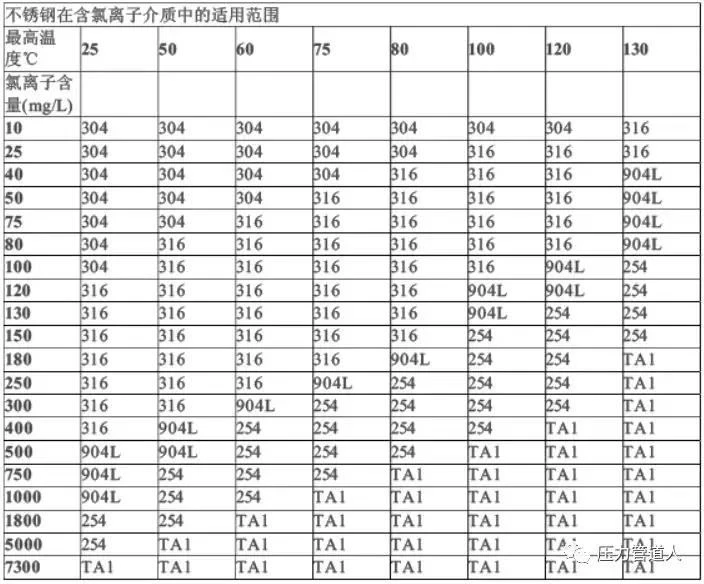
Table of material selection based on temperature and chlorine ion content
From Internet~~~


