

GATE, GLOBE & CHECK VALVES ASSEMBLY & MAINTENANCE PROCEDURES
1. Features of Construction & Operation
GATE VALVE
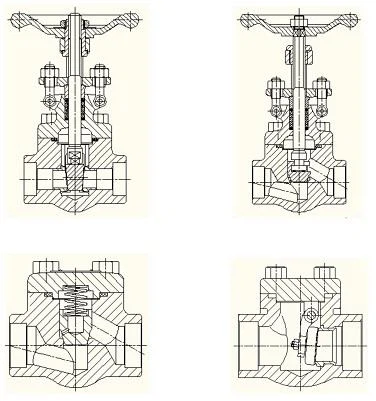
Gate Valve comprises of taper wedge, situated in between two-body seat rings, having included angle of 8 to 10 range. Guide ribs provided in the body, for smooth vertical movement secures
wedge. Spindle is engaged to the wedge, ‘T’ head self aligned joint. Spindle is engaged in the
yoke sleeve by suitable threading. Rotation of hand wheel in clockwise direction causes the yoke
sleeve to rotate and spindle moves in the downward direction along with the wedge to close the
valve.
Gate valves are used for on-off service where full flow with minimum pressure drop is desired in
full open condition. Gate valves are not recommended for throttling service. These valves are to be
used either fully closed or fully open position.

GLOBE VALVE
Globe valve comprises of round shape taper or regulating type disc. The disc is attached to the spindle by self-aligned swiveling joint. Vertical movement of disc along with spindle is governed by
rotation of hand wheel, directly fitted on spindle. Spindle is engaged in the yoke nut on the bonnet
top by suitable threading. Clockwise rotation of hand wheel leads to closing of the disc.
Globe valves are normally used for controlling the flow where certain pressure drop is permitted.
These valves can be used for on-off service also.

SWING CHECK VALVE
Swing Check valve is self-operation non-return valve. Disc opens in the direction of flow and
returns back on body seat when flow stops and seals with seat ring against back-pressure. Disc is
secured in hinge; bracket & pin arrangement, which is self aligned type and moves inside body
cavity. In larger sizes, hinge pin projects out of body to accommodate balance weight or dashpot
arrangement.

2. Maintenance
Dismantling and Servicing Instructions for Gate Valves:
Loosen the body/bonnet joint stud/nuts and remove from body, loosen the eye bolt nuts, rotate the
hand wheel in clockwise direction. Wedge will come down to closed position. Further rotate the
hand wheel in same direction, bonnet assembly will rise in upward direction. Continue the same till
spindle comes out of threaded portion of yoke sleeve. Lift the bonnet assembly to separate it from
body. Hold the spindle portion above body with left hand and pull it upward by hammering gently
on topside of body surface beyond gasket area. The spindle along with wedge will come out of
body. Observe the condition of seat portion and interior portion of body.
Clean body interior portion and seat surface thoroughly with suitable cleaning liquid check up for
any scratches on seat ring surfaces. Minor scratches should be removed by lapping with emery
paste with the help of body seat lapping fixture.
If the scratches are deep which cannot be removed by lapping, further machining may be required.
Threaded seat rings are machined with ‘Right Hand’ threading and can be removed from body with
the help of lugs provided. Where seat rings are seal welded to the body, complete body should be
loaded on machine for further rectification.
Similarly minor scratches on wedge surface should be removed by lapping with emery paste.
Deep scratches should be removed by machining and lapping. In case wedge surface is heavily
damaged the entire seat surface should be machined and machining and lapping should follow
one layer of hard facing weld deposition as per body size.
Remove old gland packing from bonnet stuffing box. Clean the bonnet surface from inside; lap the
degree surface of back seat bush with the help of suitable fixture or by spindle itself. Clean
threaded portion of the spindle. Polish the non-threaded portion of spindle on lathe machine or
grind if possible. Clean threaded portion of yoke sleeve and apply grease with the help of grease
gun through grease nipple provided on the bonnet top.
Change the body bonnet joint gasket and assemble the valve. Put new gland packing of required
size and quality into the stuffing box with open end 180 with respect to each other. Tighten eyebolt
nut equally on both sides. Lubricate the spindle-threading portion and operate the valve 2/3 times.
Procedure for repairs to seat and wedge/plug surface:
In case the leakage persists, open the body/bonnet joints and see if there is damage on the wedge
surface. To repair this type of damage following procedure is to be adopted.
For repairs by deposition of 13% chrome by arc welding the thickness of layer required is 1.6mm
minimum.
The surface should be covered uniformly with complete metallurgical bond between the surface to
be deposited and alloy.
Deposition of cobalt based alloys for stelliting on the surface or seat/wedge:
When the seat ring surface is made from alloys other than 13% Chrome use the following
procedure for stelliting:
Hardness procedure:
Expected between 38 to 42 Rc for seat Valve seat are preheated to temp of 350 to 400 degrees
Centigrade through out the section of the work piece and they are, then deposited with stellited
alloys on the specified seat area using insert gas shielded plasma ARC process with non
consumable throated (tungsten) rods.
The ARC is always directed towards the deposited alloys to minimize dilution. Dilution observed is
in the range of 5-8% for deposits of 2.50-mm thick using current range of 75-125 amperes. It has
to be ensured that the complete surface is covered uniformly and there is complete metallurgical
bond between the surface to be deposited and the alloy. Subsequent to the deposition the part is
put in a dry lime bucket for slow cooling and also to relieve the stress. The flow of the inert gas
shield should be adequate to avoid any oxide formation and also to restore all hardenable agents
and the metallic constituents in the alloy that provide higher temperature and wear resistance.
LAPPING AND FINISHING OPERATION:
Only VALVEGRIND make silicon carbide (extra coarse) lapping compound should be used. Before
starting the lapping operation on the surface of the seat/wedge, ensure that surface is properly
machined (∇∇∇ finishing), burns are removed. Put the lapping compound on the surface of the
lapping area,
and apply it on flat metallic plate (lapping plate). For proper finish, give the equal force to all
contact area, till the surface is smoothly lapped (∇∇∇∇ finish). Clean the surface and observe the
proper matching between the contact area. Before re-assembly, ensure that the contact area is
properly matched.
Stem Repair:
All the valve stems are to be repaired for the following:
♦ Straightness,
♦ Damage to head and threads,
♦ Corrosion,
♦ Pitting and taper in the portion that slides through the packing.
Straightness:
Minimum clearance for the length of the stem when measured from a straight edge laid along side
the stem, while rotated 360. The stem should be press straightened if necessary or should be re-
grounded on center less grinder.
Threads and head:
Thickness and smoothness of threads must ensure smooth operation within the stem nut. The
head must adequately engage the disc or plug.
Packing slide area:
The area that passes through packing should be free from pits and have smooth finish. Polishing
or turning of the sliding surface within pre-decided limits can achieve this. Also the taper on the
stem should be removed. If pits wear, taper or previous machining results in a reduction of the
stem outside diameter beyond acceptable limit from original size; the stem to be replaced by new
one.
Installation of socket weld end valves:
It is recommended that pipe be kept approximately 0.06” in (1.6mm) away from contact with the
bottom of the socket before starting the weld. This is to prevent problems in the cracking of the
field welds when the pipe is seated against the bottom of the socket. Valve should be welded with
the disc slightly opened using weld material (rod or wire) with an appropriate diameter to meet the
dimension and shape of the area to be welded for prevention of overheating the valves.
Important tips during the re-packing of gland:
1. While removing the old packing avoid hooks that can scratch the fine finishes of stem & stuffing
box. Soft materials such as brass or hardwood dowels are better instruments.
2. Thoroughly clean stem & stuffing box while replacing new rings.
3. Avoid handling the parts and new packing set with bare hands after cleaning, otherwise salt is
introduced which can start corrosion.
4. It is generally acknowledged that the top tow rings of packing set are most effective in sealing
the stem. Therefore, if two rings can be added to an in-service valve on back seat, there is an
excellent chance of stopping leakage.
3. Maintenance
Dismantling and Servicing Instructions for Globe Valves:
Loosen the eyebolts/nuts; remove the body bonnet joint stud/nuts. Lift the bonnet assembly from
body. Remove tack weld locking of spindle nut to disc and take out the disc from spindle
assembly. Remove the hand wheel from spindle and take out spindle from bonnet assembly by
rotating anti-clockwise. Clean the spindle-threaded portion and polish or grind unthreaded portion.
Take a light cut on taper back seat portion, if damage is more. Remove old gland packing from
bonnet stuffing box. Lap the back seat portion of bonnet bush. Check the condition of seat surface
of body seat ring and disc. Minor scratches should be removed by lapping with emery paste with
the help of suitable fixtures. Deep
scratches should be removed by machining and lapping. Removal of threaded seat rings is similar
to that of gate valve.
Assemble the disc/spindle assembly as before and assemble the valve and replace the old gasket.
Add new gland packing in the stuffing box of exact size having opened ends 180 with each other.
Apply proper lubrication to spindle threading and operate the valve 2/3 times.
4. Maintenance
Dismantling and Servicing Instructions for Check Valves:
Open the cover plate by removing body-cover stud/nuts. Open two bracket bolts and take out
assembly of hinge, bracket and disc. Separate the disc by removing split pin and disc nut. Clean
the interior portion of body with cleaning liquid. Check the condition of seat ring surface.
Rectification of seat surface is same as specified in Gate and Globe Valve
After lapping disc & seat ring, assemble the hinge/bracket/disc assembly as before and also
replace the old gasket. Assemble the cover plate on body and ensure that disc assembly sits
properly on seat ring and is also free to move inside body.
5. Important Tips to Improve Life Valves Service
In this approach maintenance work is carried out before actual repairs are required. This is to
reduce probability of valve failures and ensure availability during its service life.
Preventive maintenance program for valve may contain following points and necessary actions are
to be taken accordingly.
¾ Periodic static inspection, for any visible defects or failure such as packing or bonnet leakage
and stem condition.
¾ Periodic valve stroking & lubrication of stem threads, gears to prevent jamming and corrosion
every six month (lubricant to be used castrol ap3 or equal)
¾ Periodic packing change, to be made to ensure the packing without leakage.
¾ Periodic valve and actuator component inspection, to find out degradation of the components.
this can be carried out when line is under shut down or stand by line is available.
¾ Testing of torque and limit switches periodically, to ensure their operation in motor operated
valves.
API 602 Forged Steel Gate, Globe, Check Valves..
6. Precautions to be taken
¾ Whenever gland packing is required to be replaced under full working pressure, ensure that
back-seating arrangement is present and is functioning properly.
¾ While opening and closing of the valve please check direction of turn for open and close
(operation in opposite direction may damage the yoke sleeve).
¾ When body bonnet joints are unbolted do not forget to put new gasket while refitting.
7. Storage Instructions
¾ All valves normally after inspection at our works are thoroughly cleaned from inside.
¾ Valves with flanged ends are covered with wooden disc or rubber cover so that no dust or
foreign particles enter inside.
¾ Smaller size screwed/butt weld valves have p.v.c cover (push fit) and are packed in polythene
bags.
¾ Valves are to be stored in the warehouse or covered shed to avoid damage due to sun or rain.
¾ Ensure valves are kept on wooden planks above floor so that it is not in contact with
water/mud.
¾ For long storage ensures that plastic covers are provided and valves are fully covered.


