

Butterfly valves are classified by the relative position of the stem, disc, and body centerline, which determines the sealing method, temperature and pressure rating, service life, and applicable applications. Main types include concentric butterfly valves, double eccentric butterfly valves, and triple eccentric butterfly valves.
Concentric Butterfly Valve
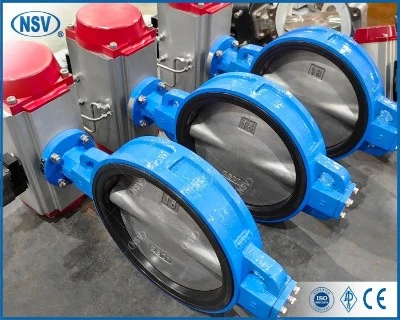
The concentric butterfly valve is a zero eccentric structure with coincident stem, disc, and body centerlines. It typically uses soft sealing materials such as rubber, EPDM, NBR, or PTFE, achieving sealing by disc compression against the seat. Advantages include simple structure, light weight, low cost, and good sealing in low pressure clean service. Disadvantages include full cycle seat friction during operation, faster wear, higher operating torque, temperature limit around 120 degrees Celsius, and pressure ratings usually PN6, PN10, or PN16. Common applications are municipal water supply and drainage, HVAC, fire water, circulating water, wastewater treatment, and ventilation ducts with ambient temperature, low pressure, and clean media.
Double Eccentric Butterfly Valve
 The double eccentric butterfly valve has two eccentricities: the stem axis is offset from the disc sealing surface center and from the body bore centerline. The disc disengages from the seat quickly after opening, contacting the sealing surface only near the final closing position, which significantly reduces friction, extends service life, and lowers operating torque. It can use soft sealing, PTFE composite sealing, or semi-metallic sealing, with higher temperature and pressure capability than concentric valves, typically PN10 to PN40 and approximately minus 30 to 150 degrees Celsius. Suitable for heating networks, circulating water, compressed air, weakly corrosive liquids, ambient temperature flue gas, and general chemical pipelines. Note that double eccentric valves are not completely friction free, as contact still occurs near the closed position. They tolerate fine, low concentration particles but are not suitable for high concentration hard particles, slurry, continuous throttling, or high pressure drop service.
Triple Eccentric Butterfly Valve
 The triple eccentric butterfly valve adds a third eccentricity to the double eccentric design, with an inclined conical sealing surface. It usually adopts metal to metal hard sealing, such as stainless steel, Stellite alloy, or tungsten carbide overlay. There is virtually no friction during operation, with sealing achieved by conical surface compression at the fully closed position. Temperature range can reach minus 196 to 600 degrees Celsius, pressure ratings cover PN16 to PN100 and above, with excellent wear, erosion, and high pressure resistance. Some designs offer bidirectional sealing and fire safe certification. Main applications include steam, thermal oil, high temperature flue gas, particle containing media, LNG cryogenic lines, high pressure process lines, and severe service in petrochemical, power generation, and metallurgical industries. Manufacturing precision requirements and cost are higher.
Selection Guidelines
PN and Class ratings are not directly equivalent. PN belongs to the European standard system and Class to the American standard system. Although values may appear similar, flange dimensions, bolt hole patterns, and pressure temperature curves differ, so the applicable standard must be confirmed from the piping specification. Pressure rating is strongly temperature dependent. A PN16 rating does not mean 16 bar is allowable at all temperatures, as permissible pressure decreases with rising temperature. Soft sealing provides excellent zero leakage at low pressure but has limited temperature and wear resistance. Hard sealing offers higher temperature, pressure, and wear resistance, but low pressure tight sealing requires higher machining precision. For particle containing media, particle concentration, size, and hardness must be evaluated, as double eccentric design alone does not guarantee erosion resistance. Wafer type butterfly valves are compact and lightweight, suitable for space constrained low and medium pressure lines. Lug type or flanged type butterfly valves provide better pressure capability and pipeline stress resistance, suitable for high pressure, large diameter, or critical service.
Summary
For ambient temperature, low pressure, and clean media, concentric butterfly valves are suitable. For medium temperature and pressure service with reduced wear and longer life, double eccentric butterfly valves are preferred. For high temperature, high pressure, steam, particle containing, corrosive, or long service life requirements, triple eccentric metal seated butterfly valves should be selected.


