

In the field of valve design and manufacturing, surface hardening processes are critical determinants of product lifespan and operational performance. Faced with mainstream technologies such as Carburizing, Nitriding, Carbonitriding, and QPQ, how does one select the appropriate process based on specific working conditions? Incorrect selection can lead not only to cost inefficiencies but also to performance failures.
The following is a technical analysis and selection guide for these four mainstream surface hardening processes.
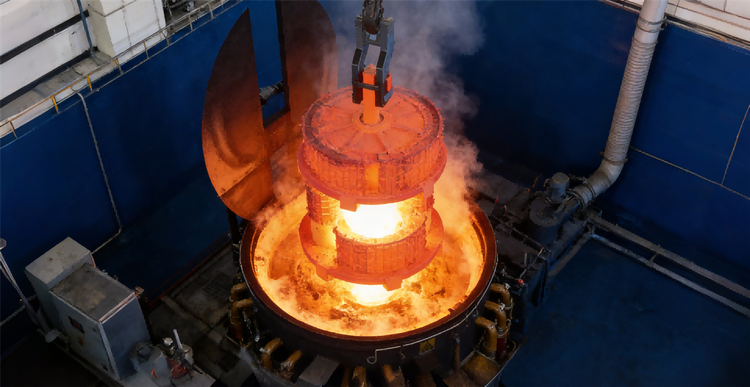
Carburizing: The Preferred Choice for Heavy-Duty Impact Components
As the most widely applied surface hardening technology, carburizing involves diffusing carbon atoms into the component surface, followed by quenching to form a high-hardness martensitic structure. This process perfectly resolves the conflict between surface wear resistance and core toughness, making it the optimal solution for components subjected to heavy loads and severe impact.
Core Advantages: Deep hardened layer, high load-bearing capacity, and excellent impact resistance.
Key Parameters: Processing temperature is relatively high;Effective case depth ranges from 0.5-2.0mm; surface hardness is approximately 58-64 HRC; distortion is significant, requiring remain machining allowances.
Applicable Materials: Low carbon steels, low carbon alloy steels, alloy steels, and powder metallurgy parts.
Typical Applications: Automotive transmission gears, heavy-duty drive shafts, connecting rods, and high-load valve components.
Nitriding: The Optimal Solution for Precision High-Wear Components
Nitriding utilizes nitrogen atoms to diffuse into the surface layer. Its primary advantage lies in low-temperature processing and minimal distortion. Since quenching is not required, the processing temperature is only 500-580°C, ensuring high dimensional stability. This makes it the ultimate solution for precision parts and high-wear components.
Core Advantages: Negligible distortion, superior wear resistance, and excellent fatigue strength.
Key Parameters: Processing temperature is 500-580°C; effective nitriding layer depth is shallow, typically 0.1-0.6mm; surface hardness is evaluated in Vickers hardness, with the nitride layer reaching 700-800 HV or higher.
Applicable Materials: Specialized nitriding steels, as well as tool steels and stainless steels.
Typical Applications: Precision grinding machine spindles, high-precision gears, measuring tools, and injection molding machine screws.
Carbonitriding: The Cost-Effective Choice for Medium-Load Components
Carbonitriding is a hybrid process combining carburizing and nitriding, where carbon and nitrogen atoms diffuse simultaneously. It retains the deeper case depth of carburizing while absorbing the high wear resistance and anti-scuffing properties of nitriding, achieving an optimal balance between performance and cost.
Core Advantages: Combines wear resistance with anti-galling properties; higher processing efficiency than carburizing with less distortion.
Key Parameters: Processing temperature is 820-880°C (lower than carburizing); effective case depth is moderate, ranging from 0.2-0.8mm; surface hardness is 58-64 HRC, slightly higher than carburizing alone.
Applicable Materials: Low carbon steels and low carbon alloy steels (e.g., 20, 45, 40Cr).
Typical Applications: Small to medium gears, axles, and cams produced in batches for automotive and machine tool applications.
QPQ: The Preferred Option for Dual Wear and Corrosion Resistance
QPQ (Salt Bath Nitrocarburizing + Salt Bath Oxidation) is a composite surface treatment technology. It not only imparts extremely high surface hardness but also provides corrosion resistance through a dense oxide film on the surface, achieving a dual breakthrough in wear resistance and rust prevention.
Core Advantages: Excellent corrosion resistance, high wear and anti-galling performance, and minimal distortion due to low-temperature processing.
Key Parameters: Nitriding stage at 520-580°C, oxidation stage at 350-430°C; compound layer thickness of 10-25μm, diffusion layer depth of 0.1-0.5mm; formation of an Fe₃O₄ oxide film provides strong salt spray corrosion resistance.
Applicable Materials: Widely applicable to medium/low carbon steels and alloy steels; particularly effective for stainless steels.
Typical Applications: High-strength fasteners, precision shafts, molds, hydraulic rods, and wear-resistant components operating in corrosive environments.
Summary and Selection Logic
To facilitate comparison, we have summarized the key indicators of the four processes below.
Comparative Analysis of Parameters
Processing Temperature: Carburizing (930-950°C) > Carbonitriding (820-880°C) > Nitriding (500-580°C) ≈ QPQ (520-580°C)
Case Depth: Carburizing (Deepest) > Carbonitriding (Moderate) > Nitriding/QPQ (Shallow)
Surface Hardness: QPQ Compound Layer & Carburizing > Carbonitriding & Nitriding
Distortion Level: Carburizing (High) > Carbonitriding (Moderate) > Nitriding/QPQ (Minimal)
Corrosion Resistance: QPQ (Excellent) > Nitriding > Carbonitriding > Carburizing
Engineer's Selection Guide
Heavy load, high impact, deep hardening required: Choose Carburizing without hesitation.
Precision parts, high wear resistance, zero distortion: Nitriding is your best choice.
Medium load, mass production, cost-effective: Prioritize Carbonitriding.
Requires both wear and corrosion resistance with complex geometry: QPQ is the ideal solution.
If you have professional inquiries, please feel free to contact NSV.


